In association with CLOWNS WITHOUT BORDERS and BOND STREET THEATRE

Drama in Sudan - continued (#3)


To begin a dramatic exploration of the issues, we gave the students an assignment to create a phrase and movement that represents one of the chosen themes.  What they created in this 10-minute exercise was amazing.  Here is one movement piece:


The students also created several deeply affecting pieces on the issue of cultural identity.  In one piece, a woman stands up in the audience and cries out “Who am I?” She runs to the stage, approaching her fellow citizens who turn away. Another approaches with same question. Little by little they come together and collectively ask the audience: Who are we?” They then burst forth with great urgency, demanding: “Who are we?! Who are we?! WHO ARE WE?!”


In another piece, a group of Arabs enter dancing a traditional Arabic dance and meet a group of Africans dancing a traditional African dance, very different from the former.  They see each other, stop and warily circle around each other. Eventually they couple up, one African and one Arab, and all come together. Out of their union, three babies are born. The children are confused. Because the north and the south are divided (as the country has recently been). They do not know who they are and where they belong. Are they Arab like their father, or African like their mother?  They collapse in a state of fear and despair.  It was quite poignant and profound!  The piece then developed so that the children torn between the two in the end find that they are enriched by both, and thusly declare “We are Sudanese.”

At the unemployment office
The students also created a compelling, and comedic, scene about the dire unemployment situation for young college graduates and how you can only get a job if you have a connection.  Additionally, they developed a piece about the lack of acceptance in society of artists and innovators; how there is no space for new innovation and no appreciation for artists. This was a recurring theme in their discussions. These young men and women want to push boundaries, and make room for new ideas and new possibilities.  As artists, they want to be free to express themselves.

At one rehearsal what began as a simple physical warm-up erupted into a spontaneous dance party.  There was such wonderful energy and expression!  "Perfect, this is how we end the play!," I exclaimed.  I wanted the show to end in a moment of celebration.  No, no, we were then told. This is not appropriate.  The students cannot move like that on stage in front of the public.  We were also told, the boys and girls cannot hold hands.  The students protested that this is what they do in life, they do it at the university and it's fine.  I advised that we acquiesce on this one.  We were lucky the government representative had said nothing so far about other aspects of our presentation.  

In developing our play, aware of the sensitivity of the issues, we focused on movement and imagery and incorporating comedic elements.  We made sure to include positive perspectives and solutions.  Two clownish narrators begin the show and provide commentary and comic relief, guiding the audience along the journey, which begins with a declaration of love for Sudan. We then present three problems: Unemployment/Freedom of Artistic Expression/Arab vs African.  We end on a positive note of togetherness: We are all Sudanese and together we can make Sudan even greater. 

There was a lot of debate about how to present things, what would be appropriate and what adjustments we might need to make.  Even as we cloaked our message in comedy and mime, it was still obvious and possibly too obvious. Talking about problems at all was just too controversial.  At the end of our last rehearsal, one of the organizers came and voiced concern about what was safe to say. Despite warnings, the students were adamant to proceed with what they had created. They said, “This is what we want to say.” “These problems exist. Others have already talked about them, we’re not the first.” “We are drama students, we are in the arts – this is what we do, we must express ourselves.” They said to me: “You asked us what the problems are. So we are telling you.” 

I assumed the students would know how far they could go.  After all, they live in Sudan, I don’t.  But as rehearsals progressed, it became clear they don't know what the boundaries are, or they don't care. This was challenging to navigate. I felt responsible because I was directing them and leading them. I was not sure how serious the situation was going to get.  At one moment it seemed it wasn’t a big deal. The next I had the impression there could be major consequences.  For the students, and for us.  I half-expected an Argo-like escape to the airport at the last minute. On dress rehearsal night rumors floated of possible protests and government-placed fire trucks at the ready to hose us down at any moment. Would we even be able to do the show?

Drama in Sudan (#2)


On our first day, close to thirty men and women showed up eager to partake in our workshops.  Most of them drama students from the University of Sudan.  My co-teacher Lydia had held auditions for a select few to join, but others heard about the program and came too.  Some were students in other disciplines but who wanted a chance to explore theater. A few others were older professionals equally eager to benefit from this unique opportunity: to have an exchange with American artists.  We couldn’t say no. In the end, we had 34 students.

Moubalara!
From the first moment, I was so impressed and so excited to work with these students -- they were really talented, expressive and 100% gung-ho. It is immensely satisfying to teach students who are hungry to learn and who appreciate everything you give them – and who give you all the more in return. Over the course of 10 days, we worked intensively together, all of us greatly invested in the creative process and each other.

 Now, imagine having only 10 days to train and create a show with a cast of 34 people! We had before us a Herculean task. Add to the challenge the fact that we were not producing an already written play. Our play was an original ensemble creation. This means we draw the material out of the group, developing it and shaping it together.  The process was helped greatly by the fact that the students were so creative and so willing to play. My mantra for the workshop became: Koulakoum moubalara!  Everybody is amazing! In the end what emerged was a powerful and poignant piece -- not fully developed nor professionally seamless -- but nonetheless a compelling performance, about 40 minutes long. 

This is not to say that there weren't bumps along the way.

Movement exercise
As talented as this group was, they still have a lot to learn, and focus was often an issue.  Making good theater requires a tremendous amount of focus, energy and discipline.  We spent the first couple of days working with the students on group movement to strengthen their cohesion as an ensemble and develop their awareness, sensitivity and concentration.  Working in such a large group is challenging, and it’s natural to lose attention – even for seasoned professionals.  But as rehearsals went along, it was time to get tough.  But as rehearsals went along, it was time to get tough.  During run-throughs of the play, many of the students would wander off, away from the stage area, instead of being in their designated spots ready for their next moment on stage.  I kept herding them back like cats. At a certain point, I got so frustrated I shouted at them in a fit of fury: "You want to be a professional actor, you need discipline!!!" (I was channeling Debbie Allen in Fame: "You want fame? Well, here's where you start paying: in sweat!").  "Focus, be ready and give your all." 

I don’t think I’ve ever done that before, quite so intensely.  But I was so passionately invested in their performance, because I knew how much it mattered to them to get to perform and have their say.  I had seen their potential and knew how great they could be.  The students told me, "We will give our all on performance night."  I countered: "Yes, but to get there you must do it now in rehearsal.  You must cultivate your performance with 100% engagement from the start!" This was our last rehearsal, there was a lot of tension built up, and the whole session culminated in a declaration of commitment, passion and love for our work together and each other.  In ten intense days, we had created a really strong bond.  We were working hard on something already complex and challenging -- and to this was added an underlying sense of urgency. Our endeavor was becoming increasingly controversial.

The Great Challenge
 We were creating a performance piece on a social issue.  Initially, the theme suggested by the YES Academy producer was national identity (in the wake of separation from South Sudan), but Lydia and I left the question open-ended. We asked our students: We are here to create a show on a social issue relevant to you. What do you want to talk about? What is important to you?  We wanted to hear from the students their own thoughts and ideas. And they had a lot to share.

From among all the topics of discussion, what emerged as the main issues were:
Voting on the theme
  • Unemployment – no work for young graduates
  • Cultural identity – are we Arab or African?
  • Acceptance of the arts – society does not accept creativity and innovation
    and most fervently,
  • Freedom of expression.

    They yearn to speak their minds as artists, to express their passions and points of view. These were all issues our students felt strongly about and that they feel are of great relevance to the Sudanese people.  It was interesting to learn about the cultural confusion. Indeed, it’s a real identity crisis for many. Ethnically the majority of Sudanese are African but culturally the majority are Arab (in North Sudan). Some look very Arabic (Middle Eastern), but most look African (black) or a mix.  All speak Arabic and are mainly Muslim. There’s great tension between the two, and African-looking Sudanese often feel discriminated against. 

    But the most burning issue among the students was freedom of expression.

    And here was our great challenge:  how create a show in which the students can speak out on what matters most to them – social justice, economic opportunity, spiritual fulfillment, freedom to express -- without criticizing the government?  I was tasked with doing social theater but under no circumstances to criticize the regime!  Bringing up any social issue can be viewed as criticism.  The last thing I want to do is stifle my students.  But I also don’t want negative consequences!


    Diplomacy in Sudan (#1)

    In November I spent two weeks in Sudan teaching theater and here, finally, is my full account of this amazing experience. It was an intensive time that proved deeply enriching and meaningful.  I worked with a group of young men and women burning to express themselves creatively within a challenging political and cultural environment.

    Quick country background: Sudan is a country in northeast Africa, south of Egypt, that recently split into Sudan and South Sudan.  Sudan has been ruled by one regime since 1989, which instituted Sharia law, and has been branded by the U.S. as a sponsor of terrorist organizations.  The country has suffered financial sanctions for over 15 years.  This past September the government cut subsidies, prices rose sharply, and people took to the streets in protest, which regime forces quickly quelled, reportedly resulting in 200 deaths.  It is a somewhat precarious time for Sudan...

    Enter our cultural diplomacy program.  For this project I joined American Voices and its YES Academy (Youth Excellence on Stage), a cultural exchange program focused on countries emerging from conflict and isolation. The YES Academy Sudan program was sponsored by the US Embassy and the Sudanese Ministry of Culture and took place in the capital Khartoum.  The program offers training in American cultural forms such as jazz, rap, hip hop and musical theater.  This time they included a social theater component: I was brought on to teach physical theater to university students and children and to create a performance piece on a relevant social issue.  We had 10 days to hone their skills and to create and publicly perform a theater piece.

    This was the first high-profile artistic exchange between the U.S. and Sudan in many years, or perhaps ever -- and we were watched closely by the Sudanese government.  They sent a government “minder”  to keep an eye on us. I imagine they wanted to ensure we were not about to corrupt their youth and foment a revolution. The government representative’s name was Obay.  I am not kidding. And he was from the Central Thought and Culture Office.  (You can’t make this stuff up.)  We were suspicious at first, and a bit nervous about his presence. But Mr. Obay in the end turned out to be an ally who strongly advocated for our program to the rest of the authorities.  There were apparently factions in the government who were not so keen on our presence. 

    A representative from the Ministry of Culture, who was our main sponsor, also came by to see how things were going.  He seemed genuinely concerned about how the rest of the world views Sudan, and appeared to think that this artistic exchange will have a real influence on improving Sudan’s image and relationship with the U.S.  I’m glad that he values the arts and its potential power!  He asked me to tell everyone that everything you heard about Sudan isn’t true.  (They are not terrorists.)  So if you see Obama, be sure to let him know.
     
    For myself, what I value is not the political impact, but the human connection.

    I worked with a group of wonderful people and we had a truly beautiful exchange.  Indeed, everyone I met in Khartoum was friendly, hospitable and good-humored. One of the things that touched me about Sudan was how keen the people are to connect with Americans and for us to have a positive view of their country.  I was met with a huge smile and the immediate question: “How do you like Sudan?” and “Why don’t you stay longer?”  Next time I will!  This was a whirlwind and a roller coaster ride. I did not really have the chance to fully experience all of Khartoum and Sudan.  There’s so much to learn still. Especially about the theater in Sudan.  

    Coming up: Working with the drama students -- koulakoum moubalara!


    On the Road Again: Sudan!

    It's been a while, and finally time to venture out into the world again!

    I just got back from an intensive two-week project in Sudan. It was an amazing, beautiful and profound experience.

    I joined the American Voices YES Academy program to teach theater to university students and youth, and to create a performance piece on a relevant social issue, such as national identity (particularly in the wake of separation between Sudan and South Sudan).

    While there I had very little internet connection, so the blogging has had to wait. I was able to post a couple of times to Facebook, and here is my first check-in:

    11/11/13: First day in Sudan. After a bumpy start with logistics, we finally started the workshops -- and the students are fantastic! I am so impressed. The kids are great and the students from the University of Sudan are so talented, so expressive, and 100% into it. What great stuff we're gonna do in the next two weeks. This is the first high-profile artistic exchange between the US and Sudan. A member of the government was there to check us out, make sure everything's on the up and up.... Hopefully he approved.

    Over the next few days, I will give more details to bring you along on my journey. Fasten your seatbelts, we're going on an intense roller coaster ride!


    HAITI: Women say: Enough!

    Bon soir de Ayiti!  La tout se yon bon bagay!  N'ap fe bel travay avek fanm Favilek!  And as you can see my Kreyol is coming along nicely.  And good thing since the women tell me "you must learn to speak Kreyol" and are excited when I do.  Both Christina and I can handle basic conversation.  One word we have learned is... 'kadejak.' It means rape. This word may not normally be considered part of daily basic conversation, but sadly, for so many women in Haiti it is. We are working with the group Favilek to create a show about gender violence which is rampant in this country.

    These women have such a strong spirit. It is hard to imagine them as victims. (Favilek -- Women Victims Get Up Stand Up -- is an organization of women who are all survivors of sexual violence). But as they expressed in their own words: they may bend us, but they cannot break us; we stumble, but we will not fall. As an assignment after our first meeting and discussion, we told them to prepare something related to the themes we had explored: justice, change, improving life for women.  A piece of text, a song, a movement. The poems they came up with are fierce and their energy passionate, indeed militant: Women say enough!  For a long time we have been walking with our hands hanging. We demand justice! And then they break into song, a rhythmic catchy tune: Men have sowed the seed of violence, but we ask that violence be replaced with love!  We are Favilek: Fanm Viktim Leve Kanpe!

    We've been working intensively and things are starting to take shape.  The first days we really focused on building performing skills through workshops -- presence on stage, exploring different levels of energy, grounding the body, character and expression.  And then exploring the theme for the show through movement and storytelling exercises.  We are now sculpting the show.  This is drawn from the various things the women have come up with during the exercises of the week, including their very first assignment.  Our team then brainstorms on all the elements and we make suggestions, inspired by what the women have given us, to shape a composition.

    The past week and a half has been amazing.  We have such a wonderful connection with the women of Favilek.  Our return was received with great enthusiasm and joy and we are enjoying a truly lovely camaraderie and mutual appreciation for each other and the work.

    We're also going about town and meeting all kinds of interesting people.  While at the street food night market feasting on barbecued chicken, plaintains and spaghetti juice (don't ask), we ran into the legendary Haitian actor Pe Toma.  All thanks to Morlon, our Haitian artist collaborator-translator-social butterfly and great connector, who knows everybody and if he doesn't he soon will.  Petoma came to visit our rehearsals and all the women were very excited because he is very famous.  Today we paid a visit to him and appeared on National Haitian Television!   So soon we will be famous too.

    That's all for now.  My time here has come to an end.  It's been a short and sweet and intense journey for me. The rest of the team is staying through March 16 to facilitate the performances the Favilek women will do around Port-au-Prince.  Stay tuned!

    Na we tale!
    Anna

    P.S.  Spaghetti juice is a delicious shake procured from a blend of potato, banana, and spaghetti.  Who in the world comes up with such a thing?!  But trusty Morlon swore to us it was really good, so we decided to try it.  Mmm... hmm. Well, it’s not bad for a sip or two, but after a few more gulps, we couldn’t take it any more.  It’s sort of like drinking batter. 

    Anna and Bond Street Theatre back in Haiti!

    Finally, we return to Haiti to work with the women of FAVILEK again from February 24-March 16, 2012 to create a show about gender violence.  Here is Bond Street Theatre's press release:


    b street logo
    FOR IMMEDIATE RELEASE 
     Contact Olivia Harris Communications Director

    Theatre Addresses Gender Violence in Haiti
    Bond Street Theatre Returns to Port-au-Prince to Create an Original Show about the Earthquake, its Tragic Aftermath, and the Ongoing Effects on Women and Girls
    New York, NY, February 20, 2012 - Bond Street Theatre returns to Haiti this Friday to continue their partnership with Haitian women's group FAVILEK. The program uses theatre to spread information about the violence women still face in the tent camps more than two years after the earthquake.

    Ten survivors of domestic and political violence founded FAVILEK (Women Victims Get Up, Stand Up) in 1991 with a theatrical response to the political coup: Ochan Pou Tout Fanm Yo Obliye (Tribute To All Forgotten Women). Bond Street Theatre met Maricia Jean, a FAVILEK co-founder, in New York City on the first anniversary of the earthquake. She requested the company's help to create a new piece about the current issues faced by Haitian women in the tent camps. 
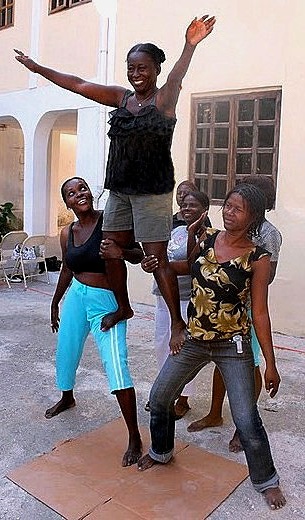
    Maricia stands tall, 2011
    Maricia stands tall at a 2011 workshop.


    When asked why the group chose theatre, Bazelais, another founding member of FAVILEK replied, "to have an outlet for our feelings of what we have endured."

    The Bond Street Theatre Haiti team spent a month in Port-au-Prince last spring performing The Flying Head (La Tet San Ko) in the tent camps and presenting workshops for women and children, thanks to the support of the American-Jewish Joint Distribution Committee. The team and FAVILEK began work on a new performance to bring information about women's rights and the disasters of gender violence to the Haitian community.
      
    The Haiti team - Anna Zastrow, Christina Pinnell, and Joshua Wynter - returns to Port-au-Prince on February 24, again thanks to the American-Jewish Joint Distribution Committee, to teach theatrical skills to the women of FAVILEK and develop the new show for performing in tent camps and other locations in Haiti to raise awareness about ongoing violence against women. The two groups intend to bring the performance to tour the USA.

    The Haiti Project will also facilitate partnerships between FAVILEK and local governmental and non-governmental organizations that need their services and performances to build the sustainability of FAVILEK and ensure more opportunities to alert community stakeholders to this pressing issue.

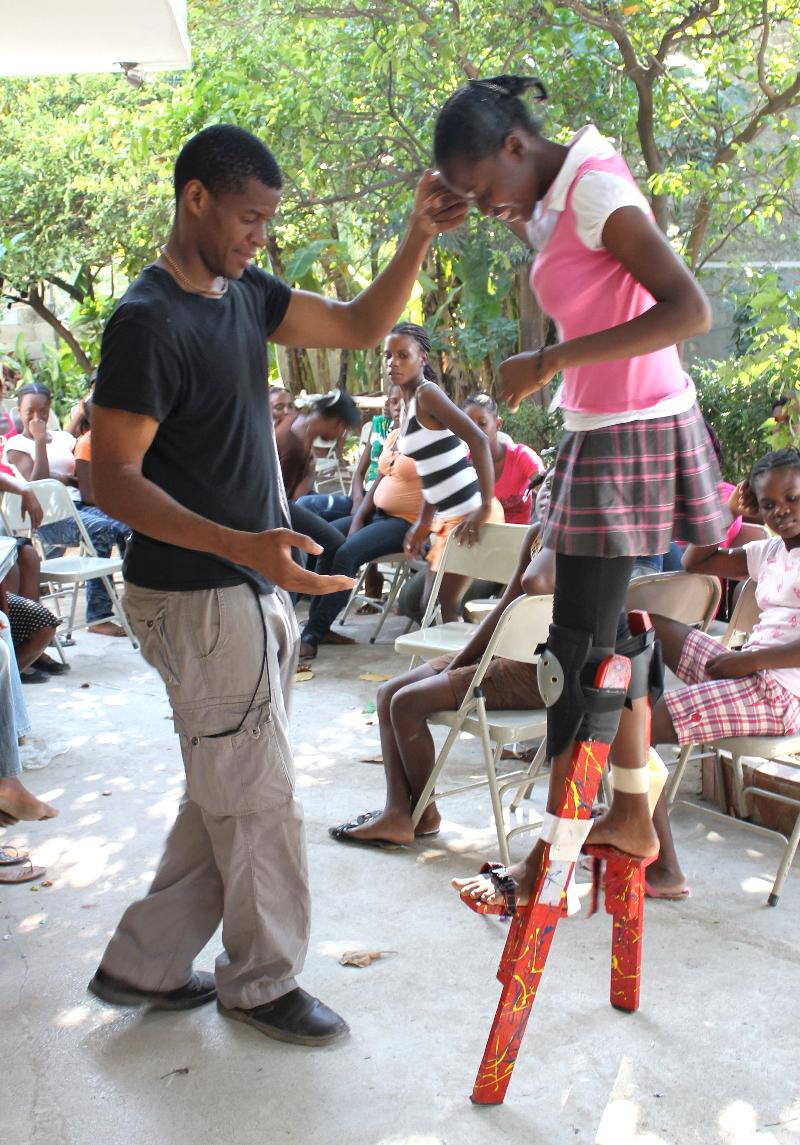
    Josh teaches stilts at KOFAVIV
    Josh teaches stilt walking.
     Two years after the earthquake in Haiti, half a million displaced people still live in tent camps and in increasingly difficult and volatile conditions.  Women in the camps face many challenges: lack of income, little to no security, supporting children alone, forced prostitution, and disease.

    Theatre provides a mouthpiece for Haitian women who are silenced in national and international discourse. The theatre arts serve as an effective means to ease the traumatic effects of disaster and poverty by providing a voice to the voiceless, a safe space to explore the issues, and stimulating creative problem solving and self-expression.

    The women of FAVILEK were enthusiastic about the 2011 project with Bond Street Theatre:"We feel so much stronger now!" "Now we feel like we can do anything!"

    Bond Street Theatre has a long history of creating successful theatre projects that promote community development and local capacity building, particularly in communities suffering from conflict, disaster or poverty. The ensemble returned February 14 from a month-long project in Myanmar, and will continue their Theatre for Social Development project in Afghanistan this March.   
       
    The Haiti Project is made possible by a generous grant from the American-Jewish Joint Distribution Committee, an organization that provides relief and development in some of the most crucial areas around the world, a grant from the US Embassy in Port-au-Prince, and contributions from individual donors.

    For more information or to schedule an interview in the US or Haiti, please contact Olivia Harris at 212-254-4614 or olivia@bondst.org. 

    Bond Street Theatre, founded in 1978, creates theatre that crosses cultural borders and initiates theatre-based projects for education, conflict resolution and healing in areas of conflict and poverty globally. The company collaborates with local artists to enjoy the benefits of artistic exchange and promotes the value of the arts in shaping a peaceful future.  Recipient of a MacArthur Award, the company has also received support from the Trust for Mutual Understanding, ArtsLink, the Theatre Communications Group, Mellon Foundation, Ford Foundation, Association for Performing Arts Presenters, Asian Cultural Council, US Institute for Peace, US Bureau of Educational & Cultural Affairs, NEA, US Embassies, and others, and performs in theatres and festivals worldwide.

    Bond Street Theatre is a non-profit organization, and an NGO in association with the UN-DPI. 
    Artistic Director: Joanna Sherman     
    Managing Director: Michael McGuigan
    Communications Director: Olivia Harris 

    Bond Street Theatre -- 2 Bond Street,  
    New York, NY 10012 USA

    Find us on Facebook Follow us on Twitter Visit our blog View our photos on flickr View our videos on YouTube
    FOR FURTHER INFORMATION and STORIES: 
    American Theatre article about Bond Street Theatre in Afghanistan.
    American Theatre article about Burma: "Can Laughter Set You Free?" by Michael McGuigan
    Video: Theatre project: Herat, Afghanistan 
    Video: Theatre project with women in Haiti
    Video: Theatre collaboration in Burma
    Video: Beyond the Mirror: NYC performance 


    Bond Street in Afghanistan again!

    Bond Street is back in Afghanistan, just in time for the Kabul National Theatre Festival,  Sept 22-26, 2011 and staying until Nov 2. 

    This time our Theatre for Social Development project continues with a new exciting theater group called White Star, based in Kabul and comprised of Kabul University graduates who are eager to breathe new life into theater arts in Afghanistan and bring important social information to the community through compelling and uplifting spectacles.


    I am staying behind and holding up the fort back in NYC this time around. You can follow along the journey by reading my good friend and colleague Kayhan Irani's blog, who has joined Joanna & Michael on the road. Check out these posts:  Kabul Goes to My Head, Bigger than Me, Sisters Are Doing It, Not Just a Banana.

    And updates from Michael and Joanna can be found on the Bond Street Blog.

    -